


Subsidence of concrete floors and slabs
Industrial concrete floors, foundation slabs, and surfaces in logistics centers, warehouses, production facilities, and other commercial properties are designed for long-term use under significant static and dynamic loads. However, even well-constructed structures can gradually lose stability due to changes in the subgrade, leading to the uneven settlement of specific areas.
The root cause is often not the concrete structure itself, but the deformation of the underlying soil. Factors such as the gradual compaction of fill soil, the washing away of fine particles by water, fluctuations in the groundwater table, inadequate base compaction during construction, or years of vibration from machinery and vehicles reduce the soil’s load-bearing capacity. Consequently, the structure no longer distributes loads evenly, resulting in localized subsidence and internal stresses.
For industrial facilities, the situation is often complicated by the constant movement of forklifts, stackers, and heavy-duty vehicles, as well as heavy loads from racking systems. If the subgrade loses load-bearing capacity—even locally—the settled concrete floor develops irregularities that rapidly worsen under operational loads.
Additional contributing factors may include utility system failures, soil washout, poor drainage, nearby construction work, or increased operational loads that were not accounted for during the design phase.
Cracks in the concrete floor are among the first visible signs of problems. Initially, they may be minor, but as deformation progresses, their width and length increase. In many cases, cracks also appear near expansion joints, columns, equipment foundations, or along slab joints. If the issue is not addressed at an early stage, even a small crack can mark the beginning of extensive deformation affecting the entire structure.
Cracks in self-leveling flooring are becoming a distinct issue for modern manufacturing facilities. In most cases, these cracks result from deformation of the concrete base rather than a defect in the polymer coating itself.
Although cracks are the most visible sign, problems with the subgrade beneath the slab can manifest in other ways. Subsidence may occur without damaging the slab itself; however, the settling of the underlying soil can cause the slab to tilt, leading one edge to sink while the opposite edge rises. The resulting height difference at slab joints can impede the movement of stackers, pallet jacks, forklifts, and other equipment. As the slab’s tilt increases, the situation becomes increasingly hazardous for stationary equipment as well: precision machinery may produce defective goods, and product racking systems could tip over. Furthermore, numerous localized depressions across the floor area can cause the slabs to rock or become unstable under load.
An additional complication is that voids beneath the slab tend to accumulate moisture over time, which accelerates uneven subsidence and adversely affects the concrete structure.
Consequently, merely repairing the surface cosmetically without addressing the root causes of the subsidence offers only a temporary solution.
What risks does the subsidence of concrete slabs pose?
For manufacturing plants, logistics centers, and warehouse complexes, concrete floor deformation is not merely an issue of the building’s appearance. The consequences directly impact personnel safety, equipment operation, and the company’s financial performance.
Even minor surface unevenness subjects forklifts, automated transport systems, stackers, and warehouse machinery to additional impact loads. This leads to accelerated wear on wheels, suspension, and undercarriage components, as well as increased maintenance costs.
If the floor subsides in a high-bay storage area, there is a risk that racking structures will lose their vertical alignment, compromising the safety of stored goods. On production lines, even slight elevation differences can disrupt the operation of high-precision equipment.
Uneven settlement increases the load on specific sections of the concrete slab, accelerating crack formation, joint deterioration, and the overall degradation of the structure’s condition. Water ingress can cause soil washout, further accelerating the deformation process.
For enterprises, this means:
- increased operating costs;
- risk of accidents;
- production downtime;
- restricted use of certain areas;
- costly major repairs in the future.
That is precisely why modern enterprises are increasingly choosing technologies that allow the cause of subsidence to be eliminated without dismantling concrete slabs or causing prolonged interruptions to production processes.
Faq
Do cracks always indicate structural failure of the slab?
No. Cracks are often merely an indicator of foundation settlement. Stabilizing the soil in a timely manner can help avoid major repairs.
Will it be necessary to dismantle the concrete floor?
No. Modern injection-based ground stabilization technologies allow for the restoration of the soil’s load-bearing capacity and the leveling of the structure without dismantling the slabs.
How to Fix Concrete Slab Settlement Without Removal: Georesin Floor Lifting and Deep Lifting
Traditional methods for repairing concrete floors typically involve removing slabs, replacing the sub-base, re-concreting, and shutting down facility operations for an extended period. For industrial plants, logistics complexes, production workshops, and warehouses, such an approach entails not only significant financial costs but also losses due to forced downtime.
That is why modern geotechnical engineering increasingly employs Georesin Floor Lifting and Georesin Deep Lifting injection technologies for sub-base strengthening; these methods allow the root cause of subsidence to be addressed without dismantling the concrete structure.
Unlike cosmetic repairs or localized surface restoration, Georesin technologies work directly with the soil foundation. A specialized geopolymer resin is injected beneath the slab through small access holes under strictly controlled conditions. As it expands, the material fills voids, compacts weak soil areas, displaces water, and significantly increases the sub-base’s load-bearing capacity.
If the structure has shifted from its design position, the controlled expansion of the geopolymer allows the slab to be gradually returned to the required elevation. All operations are accompanied by laser monitoring, ensuring lifting precision down to the millimeter.
Georesin Floor Lifting — when it is necessary to lift the slab
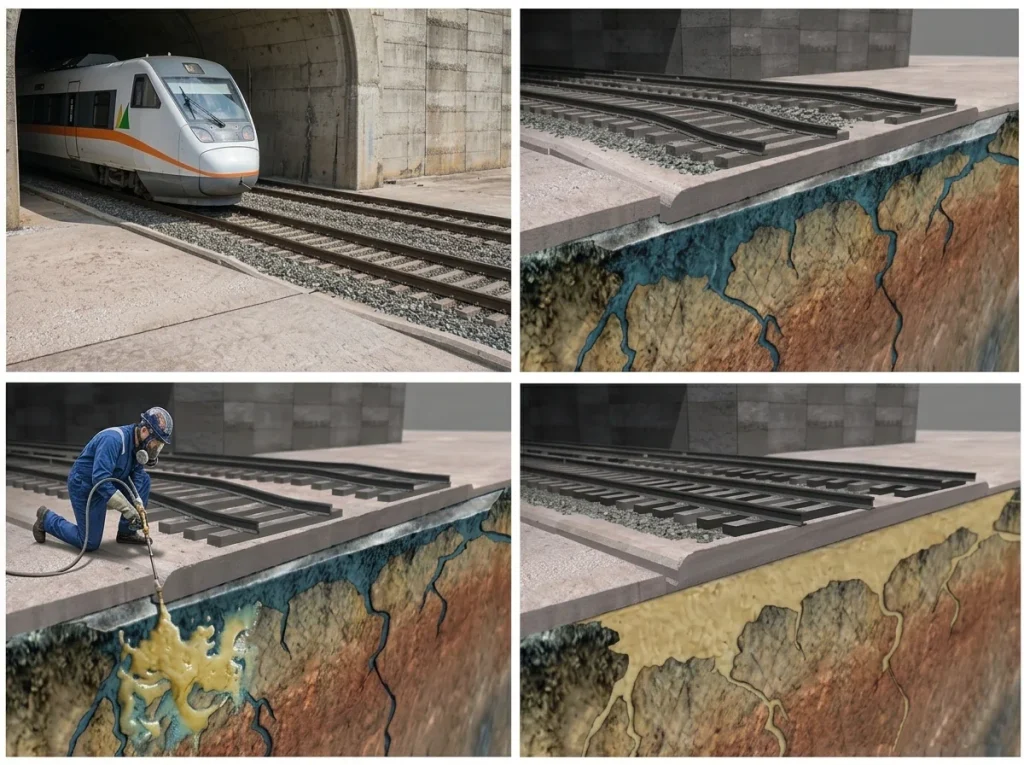
Georesin Floor Lifting It is used when the primary problem is localized settlement of a concrete floor or slab.
It allows:
- raise the concrete slab to the design level;
- eliminate height differences;
- restore surface evenness;
- remedy deformations near expansion joints;
- stabilize the base beneath warehouse and industrial floors..
Upon completion of the work, the floor is ready for immediate use, which is particularly important for facilities with continuous production cycles.
Georesin Deep Lifting — when the problem lies deeper
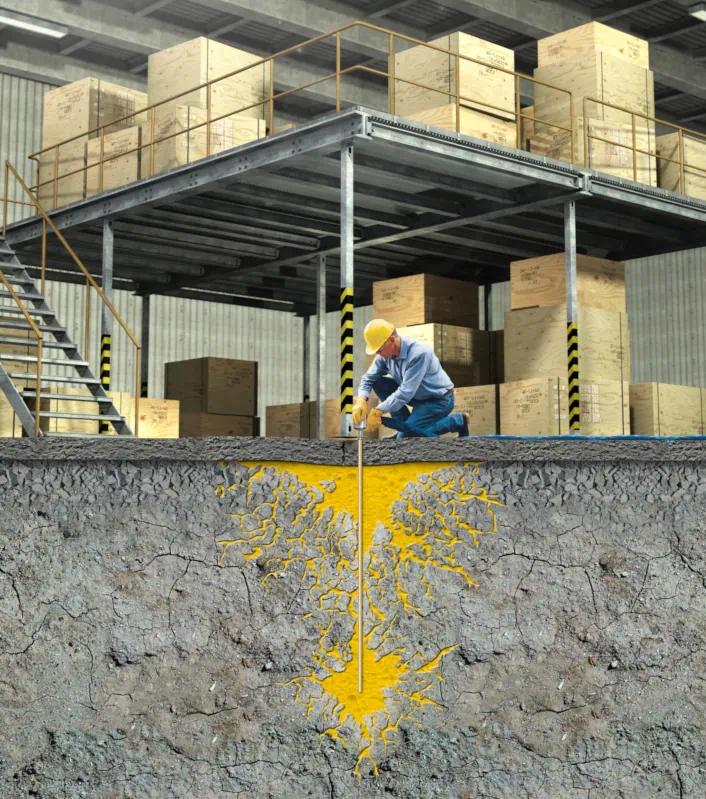
In cases where deformations are caused by the settlement of deep foundation layers, a technology is used Georesin Deep Lifting.
The injection material is introduced to the required depth through special injection tubes, where it strengthens weak soils directly beneath the foundation or concrete slab.
This approach allows for:
- increase the load-bearing capacity of the soil;
- reduce further settlement;
- stabilize foundation structures;
- restore the functionality of the foundation without extensive earthworks.
Often, the combination of Deep Lifting and Floor Lifting technologies yields the best result: first, the weak subgrade is strengthened, followed by the controlled lifting of the concrete structure to the design level.
Faq
Why can’t you simply pour a new concrete screed?
An additional screed does not eliminate the cause of the deformation. If the weak soil remains unchanged, the new concrete will also begin to settle, and cracks will reappear.
Why do traditional foundation reinforcement methods often fail to solve the problem?
Solutions effective for stabilizing individual foundations cannot ensure the precision required to lift a structure to a specific level. High lifting precision can be achieved only through the use of geopolymers, thanks to their rapid action and the ability to control the injection process.
Why doesn’t replacing the concrete slab always solve the problem?
Even a brand-new slab will begin to deform again if a weak or loose base remains beneath it. That is precisely why it is necessary to eliminate the root cause of the subsidence.
What is the main advantage of the Georesin geopolymer injection method?
The Floor Lifting and Deep Lifting technologies simultaneously strengthen the soil base and, if necessary, allow the concrete slab to be returned to its design position without dismantling the structure or halting most production processes. Moreover, this is the only technology capable of ensuring lifting precision down to 1 mm.
Areas of application
“Geotechnical Engineering Systems” solutions based on Georesin technologies are successfully used for repair and stabilization:
- industrial enterprises and their production workshops;
- logistics centers and warehouse complexes;
- shopping and entertainment centers;
- aviation infrastructure;
- railway and road infrastructure;
- ports and berths;
- energy facilities;
- agricultural enterprises.
The technology works effectively both on localized areas and beneath large surfaces where traditional repair is economically unviable or technically complex.
Comprehensive solutions
Each site presents unique geological conditions, structural characteristics, and causes of deformation. For this reason, specialists from “Geotechnical Engineering Systems” begin by conducting a technical assessment to identify the causes of subsidence and evaluate the condition of the soil foundation.
Based on the data obtained, the optimal technology is selected—either Georesin Floor Lifting & Deep Lifting, or a combination of both. This approach makes it possible not only to address the consequences but to eliminate the root cause of the deformation, restore the foundation’s load-bearing capacity, and return concrete slabs to their design position—all without the need for demolition, prolonged downtime, or large-scale construction work.
The integrated use of modern geopolymer technologies ensures rapid execution, minimal disruption to production processes, and long-lasting results. That is why Georesin solutions are widely used today at facilities where operational continuity, safety, and structural reliability are of critical importance.