

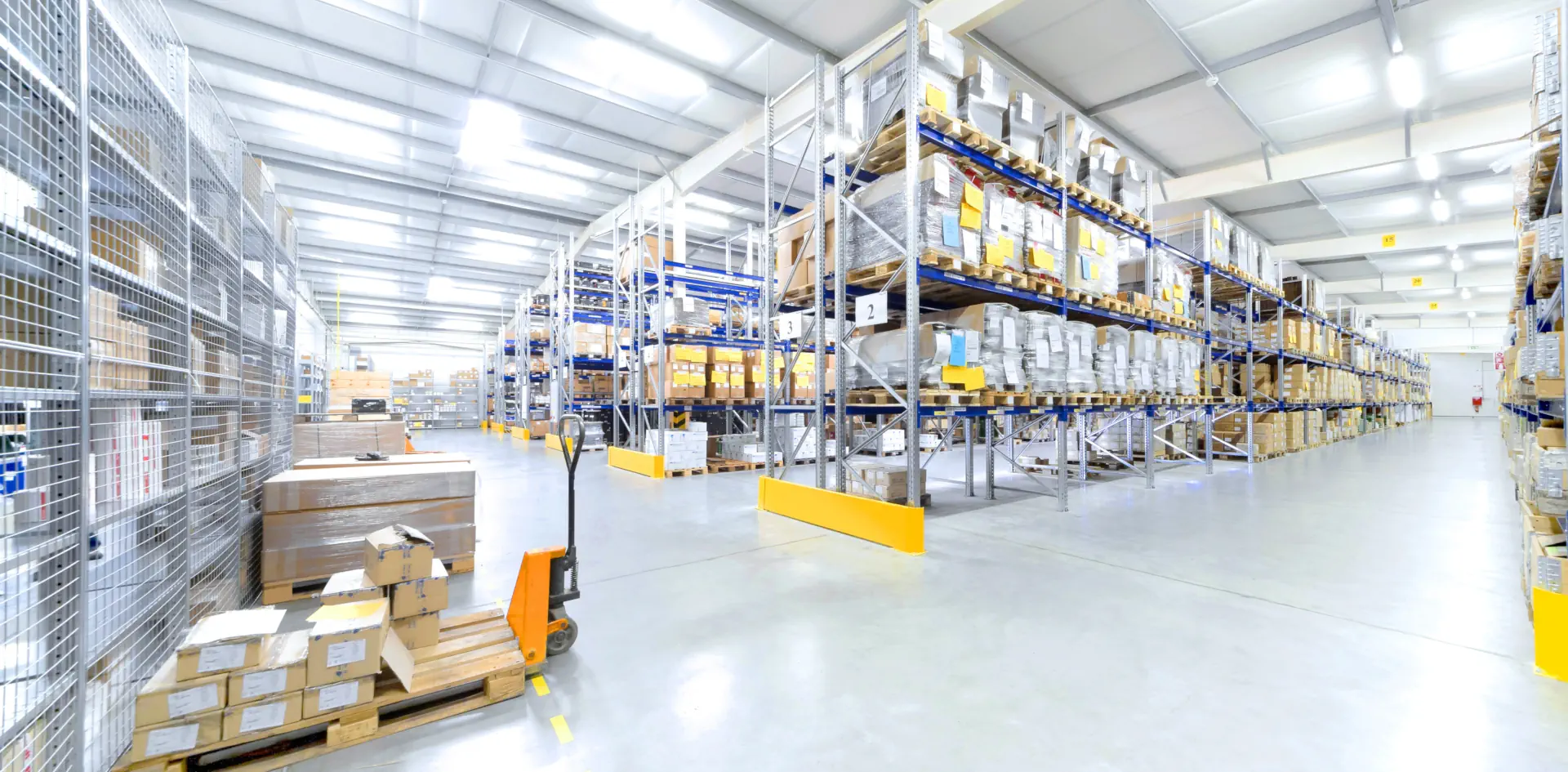
Warehouse and logistics complexes
Warehouse and logistics complexes are facilities subject to stringent requirements regarding the reliability of the subgrade, foundations, flooring, and surrounding infrastructure. The large building footprints and significant static and dynamic loads—imposed by racking systems, warehouse machinery, freight vehicles, and processing equipment—necessitate a stable soil base throughout the entire service life of the facility.
A distinctive feature of such facilities is the scale of potential deformations. Even localized soil subsidence or settlement of a specific floor section can affect the operation of warehouse equipment, the alignment of racking systems, the functionality of doors and loading docks, and the integrity of foundations and other structural elements. For large logistics complexes, rectifying such defects using traditional methods often entails shutting down specific zones or the entire facility, dismantling structures, and incurring significant costs.
“Geotechnical Engineering Systems” employs a suite of technologies for soil stabilization, structural realignment, foundation strengthening, crack repair, and the protection of underground structures. Solutions are selected based on the structure’s design, the nature of the deformations, and its operating conditions.
Common problems of warehouse and logistics complexes
Operational loads in warehouse facilities are distributed unevenly. Certain areas may be subjected to significantly higher loads due to the placement of racking systems and processing equipment, as well as the movement of forklifts or the constant traffic of freight vehicles.
Deformations may be caused by insufficient soil bearing capacity, uneven compaction of the base, changes in moisture content, soil saturation, washout of particles, the presence of voids, or localized changes in the base’s operating conditions.
As a result, the following may occur at the facilities:
- subsidence of concrete floors and slabs;
- differences in floor levels;
- cracks in concrete structures;
- foundation deformations;
- localized subsidence beneath column foundations;
- uneven settlement of specific building sections;
- deformation of ramps, loading dock areas, and access aprons;
- formation of voids beneath slabs and foundations;
- cracks in walls and partitions;
- compromised waterproofing of underground structures.
For a logistics complex, such defects are significant not only from a structural standpoint; they directly impact operational processes and the continuity of the enterprise’s operations.
Loss of bearing capacity of the soil foundation
One of the key areas of work at warehouse facilities is restoring the load-bearing capacity and stability of the soil base without extensive structural excavation.
Georesin injection technologies can be used for this purpose, allowing for targeted soil treatment via a system of injection boreholes. Geopolymer compounds fill voids, densify the soil, and form a stable mass within the injection zone.
Depending on the task at hand, the technology can be used for:
- densification of weak soil zones;
- filling of voids beneath slabs and foundations;
- increasing the load-bearing capacity of the subgrade;
- stabilization of foundations;
- compensation for local settlements;
- restoration of structural design elevations.
Injection work is carried out through small access holes; therefore, in many cases, there is no need to dismantle the floor, foundation, or other structures.
Subsidence of concrete warehouse floors
The floor is one of the most heavily loaded structural elements of a warehouse complex. Its deformation can create problems for the movement of forklifts, the operation of automated warehouse systems, the installation of racking, and the use of processing equipment.
Georesin floor lifting technologies enable the lifting and stabilization of concrete slabs by injecting geopolymer material beneath the structure.
The method can be used for localized or large-scale restoration of slab levels without completely dismantling the floor. The injected material fills the voids beneath the slab and generates controlled pressure, allowing the structure to be raised to the required elevation.
This is particularly relevant for operational warehouse complexes, where a complete floor replacement would mean a prolonged shutdown of a significant portion of the facility.
Damage to foundations and support zones
The foundations of warehouse buildings often sustain significant vertical loads transmitted through the frame columns. Uneven settlement of the subgrade beneath individual foundations can alter the geometry of the structural system and lead to the development of secondary deformations.
Georesin injection technologies can be used to stabilize the base, while Stati-Pile extendable micropiles are employed when an additional support system is required.
Stati-Piles enable the transfer of structural loads to deeper, more stable soil layers. Compact equipment allows for operations in areas with limited access and without extensive excavation.
Such solutions can be used beneath column footings, in localized sections of the foundation system, under extensions, and for other structures where the standard construction of new foundations is technically challenging.
Cracks in walls and concrete structures
Cracks in the concrete and brick structures of warehouse buildings can result from differential settlement, thermal effects, material shrinkage, or changes in foundation operating conditions.
Stati-CAL systems—Stati-Bar helical bars and Stati-Tie anchoring systems—can be used to restore structural integrity.
Stati-Bars are used for crack stitching and localized masonry reinforcement. The spiral shape of the bar ensures mechanical interlock with the structural material, enabling effective reinforcement without extensive masonry dismantling.
Stati-Tie can be used to tie together and stabilize structures, including in situations where it is necessary to restore the structural interaction between individual building elements.
Damage to foundation waterproofing and groundwater issues
For warehouse and logistics complexes, protecting foundations, underground spaces, pits, technical areas, and other structures against water ingress is of great importance.
Damage to the waterproofing may be associated with crack formation, structural deformations, seepage through joints, or localized damage to the waterproofing layer.
Injection technologies allow for the injection of cracks, joints, and other water ingress areas without fully exposing the structure. Injection materials penetrate the defective areas and form a waterproofing barrier.
For warehouse facilities, this makes it possible to carry out localized repairs without large-scale structural dismantling and with minimal disruption to the building’s operations.
Solutions for adjacent infrastructure
The operation of a logistics complex depends on more than just the condition of the building itself. Key elements include loading areas, ramps, access roads, maneuvering zones, parking lots, and other concrete and asphalt surfaces.
Deformation in these areas can result from uneven soil compaction, heavy traffic loads, saturation of the sub-base, or the formation of voids.
Injection technologies can be used to locally stabilize the sub-base and restore the level of specific pavement sections. This enables repairs to be carried out without the need for large-scale demolition and reconstruction of the entire structural layer.
Why injection technologies are effective for logistics facilities
For an operational warehouse or logistics complex, the repair method is just as important as the result itself. It is essential not only to eliminate the cause of the deformation but also to minimize the impact of repair work on the enterprise’s operations.
Injection technologies have a number of features that are particularly important for this type of facility:
- minimal earthworks;
- no need for large-scale structural dismantling;
- ability to work in specific, localized areas;
- use of compact equipment;
- feasibility of carrying out work in occupied buildings;
- reduced structural restoration time;
- possibility of phased repair of large areas;
- controlled impact on the soil base and structures.
This makes it possible to view injection technologies not merely as a method for repairing existing damage, but as a tool for restoring the facility’s operational characteristics with minimal disruption to its operation.
A comprehensive approach to warehouse and logistics complexes
A characteristic feature of large logistics facilities is the interdependence of their structural elements. Soil settlement beneath the concrete floor, deformation of a column foundation, a wall crack, or a failure in waterproofing may manifest in various ways, yet all stem from changes in the operating conditions of the foundation.
Therefore, the effective restoration of the structure requires a comprehensive assessment of the causes of deformation and the selection of a technology suited to the specific structural situation.
“Geotechnical Engineering Systems” combines Georesin, Inject, and Stati-CAL solutions for working with soils, foundations, and concrete and brick structures.
This approach enables a wide range of tasks to be addressed—from localized void filling and lifting of settled slabs to foundation strengthening, crack reinforcement, and waterproofing restoration.
For warehouse and logistics complexes, this means the ability to repair and reinforce specific structural elements without the need for large-scale disruption to the facility’s overall operations.