

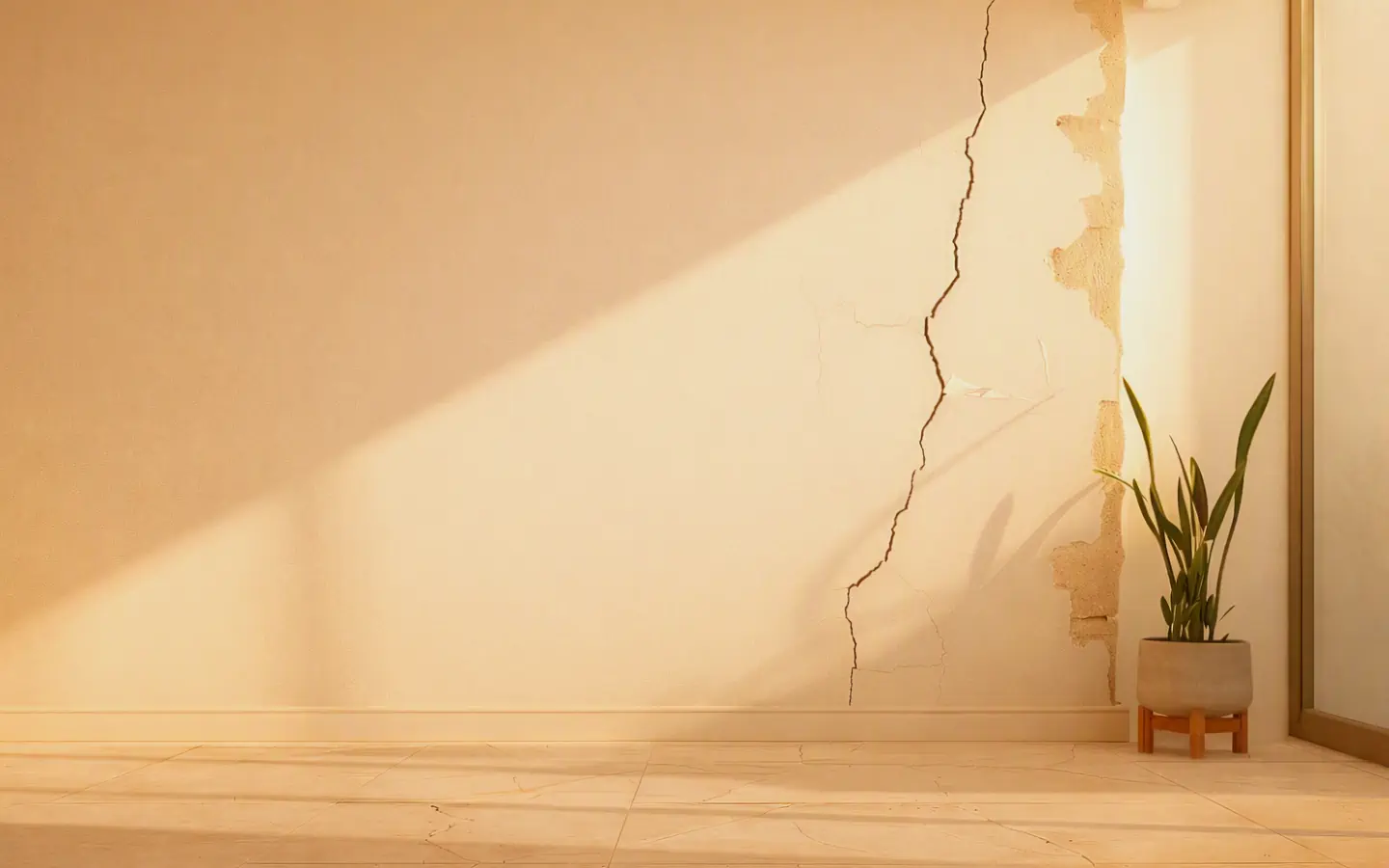
Why do cracks appear in walls?
Wall cracks are among the most common signs of building deformation. For industrial, commercial, administrative, and historical structures, it is important to recognize that a crack is merely the visible manifestation of an underlying process. The processes causing the cracking typically occur within the structure itself or in the soil beneath the building. Damage that appears identical may stem from fundamentally different causes and require distinct engineering solutions.
One of the most frequent causes is the uneven settlement of the building or specific sections of it. If the soil beneath different parts of the foundation varies in its properties, it will deform unevenly under load. Similar issues arise from inadequate compaction of fill material, localized soil loosening, fluctuations in the groundwater table, or the washing away of soil particles. Consequently, the foundation shifts unevenly, subjecting the walls to additional tensile and shear stresses.
Other potential causes include utility failures, excavation or piling work near the building, constant vibration, additional loads, or structural variations in the foundations within a single facility. These factors are particularly relevant for industrial and commercial buildings, where renovations and changes in functional use can significantly alter load-transfer patterns.
The nature of the damage is also influenced by the wall material. Brickwork, concrete panels, block structures, and aerated concrete differ in terms of stiffness, strength, and deformation capacity. Consequently, the same foundation deformation can manifest in different ways.
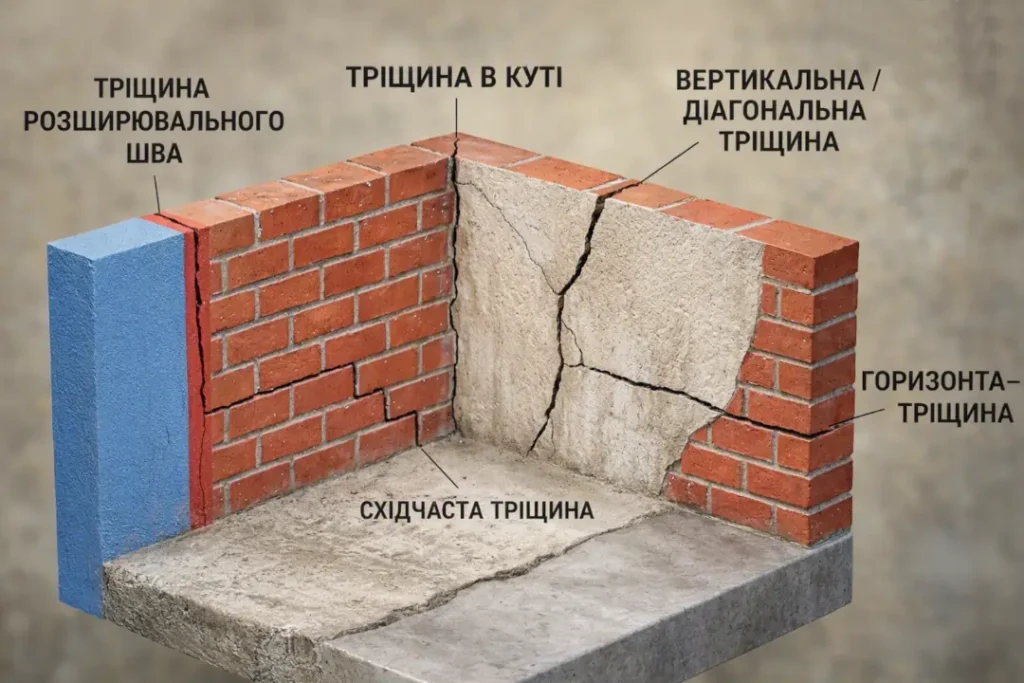
Based on orientation, cracks are broadly categorized as vertical, horizontal, or diagonal. Horizontal damage may be associated with uneven deformation and horizontal loads; vertical cracks often result from overloading or localized structural stress; and diagonal cracks frequently indicate uneven settlement in a specific area. However, the orientation of a crack does not constitute a diagnosis in itself; determining the cause requires considering its location, width, depth, extent, relationship to other defects, and progression over time.
Particular attention should be paid to cracks in corners, near openings, at points where floor slabs bear on supports, and at the junctions of dissimilar structural elements. Significant local stresses tend to concentrate in these areas. If, alongside such cracks, one observes misaligned doors and windows, sloping floors or ceilings, gaps between structural components, or other geometric distortions, the issue should be treated as a potential structural problem. Cracks exceeding 1 mm in width or those that propagate over time require professional assessment, especially when accompanied by other signs of deformation.
What danger do cracks in the walls pose?
The danger is determined not by the mere appearance of a crack, but by whether the deformation process is continuing and which part of the structural system it affects.
If the damage is caused by foundation settlement, the wall itself may serve merely as an “indicator” of the problem. As the foundation continues to shift and loads are redistributed, the crack gradually widens. It may extend to adjacent areas, floor slabs, lintels, and other structural components. We view structural cracks as a consequence that must be considered in conjunction with an analysis of the foundation and the underlying soil.
For a B2B facility, this can mean far more than just the need to repair the interior finish. Wall deformation can compromise the building’s airtightness and affect the performance of utility systems, the geometry of openings, and the condition of floor slabs, facade systems, and industrial equipment. In a manufacturing or warehouse facility, this can lead to operational limitations and additional costs.
Moisture ingress through cracks poses a distinct risk. Water can penetrate concrete and masonry structures, accelerating material deterioration and creating conditions for the corrosion of reinforcement in reinforced concrete. Injection technologies are employed, among other things, to restore structural integrity and reduce water permeability.
F.A.Q.
Does a crack indicate a foundation problem?
Not always, but in cases of uneven settlement, the foundation and the soil are often the first areas that need to be inspected.
Can the crack simply be filled in?
It is too early to determine the cause. If the wall continues to deform, the crack will reappear.
Comprehensive solution:Georesin + Inject + Stati-CAL
Effective crack repair begins not with the choice of repair compound, but with identifying the mechanism behind their formation. If the problem stems from the soil base, the foundation must be stabilized. If the wall itself is damaged, its structural integrity must be restored. If there are voids or areas of loose material within the structure, they must be filled with injection material.
That is precisely why “Geotechnical Engineering Systems” can combine three different groups of technologies.
Georesin — elimination of the cause
If cracks have appeared due to uneven settlement or a reduction in the load-bearing capacity of the soil base, stabilizing the foundation becomes the primary task.
Georesin technologies involve injecting a geopolymer material into the soil base through small access holes. The material fills voids and zones of loose soil, compacts the ground, and increases the load-bearing capacity of the foundation. Under appropriate conditions, the controlled expansion of the injected material can also be used to correct the position of subsided structures.
The key advantage of this approach is that it addresses the root cause. Instead of endlessly repairing cracks, the “foundation-soil” structural system is stabilized.
Stati-CAL — structural restoration of the wall
Once the cause of the deformation has been stabilized, structural reinforcement of the wall itself may be required. Stati-CAL systems are used for this purpose, specifically Stati-BAR helical bars and anchors designed to create or restore structural connections.
Such reinforcement enables the transfer of loads across the damaged zone, ties together separate sections of masonry, and restores the wall’s ability to function as a unified structure. Stati-CAL offers solutions for wall strengthening, crack repair, the restoration of reinforcement bands, the reinforcement of openings, and the tying together of structurally distinct or separating elements.
This approach is particularly important for cracks located at corners, near openings, and in areas of high stress concentration. The goal is not merely to bridge the line of damage but to restore load transfer between structural elements.
Inject — restoration of inner integrity
A visible crack does not always reflect the full extent of the damage. Micro-cracks, capillaries, voids, and localized areas of reduced density may remain within the concrete or masonry.
The injection technology allows for the introduction of injection material directly into the structural body via a system of packers. Polymer injection materials are used for concrete and reinforced concrete, while materials selected based on the specific structure and properties are used for masonry. Injection makes it possible to fill internal voids and cracks, restore structural integrity, and reduce the structure’s water permeability.
Thus, the system can operate at three levels:
Georesin → soil base and foundation stabilization.
Stati-CAL → structural reinforcement and restoration of wall connections.
Inject → filling of cracks and voids, and restoration of internal integrity.
Not every structure requires all three technologies. The combination used is determined following an inspection, an analysis of the nature of the cracks, and the identification of the cause of the deformation.
Why doesn’t traditional renovation yield the desired result?
Why might reinforcing a wall without repairing the foundation be insufficient?
If the wall continues to undergo displacement due to foundation deformation, the new reinforcement will operate under conditions that remain unfavorable. Therefore, we recommend first identifying the cause of the cracking and stabilizing the foundation if necessary, before proceeding with the structural restoration of the wall.
Why can’t the crack simply be widened and filled?
Joint raking and filling can be part of the proper repair of a stable crack. However, in cases of active settlement or wall movement, a repair compound cannot replace structural reinforcement and foundation stabilization.
Why is a traditional concrete jacket not always the optimal solution?
Extensive reinforcement can require significant intervention in the existing structure, increase its dead load, and necessitate the removal of finishes. We use Stati-CAL helical reinforcement and anchors, which allow for localized strengthening and enable the solution to be tailored to the specific damage pattern.
What is the advantage of injection over surface-only repair?
The injection material is introduced into the interior of the structure and can fill defects that cannot be remedied by conventional surface repair. This is particularly important for thick concrete and masonry structures, where a visible crack represents only a portion of the damaged area.
The comprehensive solutions offered by “Geotechnical Engineering Systems” are applied in industrial facilities, warehouse and logistics complexes, administrative and office buildings, retail properties, multi-story structures, underground constructions, and other B2B facilities. These technologies are particularly important for operational facilities, where repairs must be carried out with minimal disruption to production processes. Stati-CAL specifically highlights the application of structural solutions at industrial sites—including for damage caused by equipment vibration—while “Inject” technologies can be used to repair concrete and masonry without costly dismantling.
Ideally suited for facilities where repairs must be carried out with minimal disruption to production processes.


A comprehensive solution from Geotechnical Engineering Systems
A crack in a wall is not merely a technical issue in itself; it indicates that a specific part of the building system is undergoing deformation, the precise cause of which must be identified.
That is why effective repair begins with assessment and diagnostics, rather than the selection of a material to fill the crack. It is essential to determine whether the defect is linked to the foundation and soil, the behavior of the wall itself, a specific structural connection, moisture, vibrations, or a combination of these factors.
“Geotechnical Engineering Systems” employs a comprehensive approach: Georesin addresses the geotechnical causes of deformation and stabilizes the foundation; Stati-CAL restores the structural integrity of walls and specific connections; and Inject allows for the filling of cracks and internal voids.
This approach makes it possible to move beyond merely masking the symptoms and instead systematically restore the entire system—from the soil base to the above-ground structures. For the owner or technical director of a B2B facility, this means reduced risk of recurring damage, minimized large-scale demolition, and the ability to continue operating the building with predictable performance characteristics following the repair.
When cracks have already appeared, the primary question should not be “what do I use to fill it?” but rather “why did it occur, and what needs to be stabilized to prevent it from reappearing?” The answer to this question determines the appropriate repair technology.