

Cracks in concrete
How to distinguish natural settlement from dangerous structural deformation
The nature of cracks in concrete: is shrinkage always the cause?
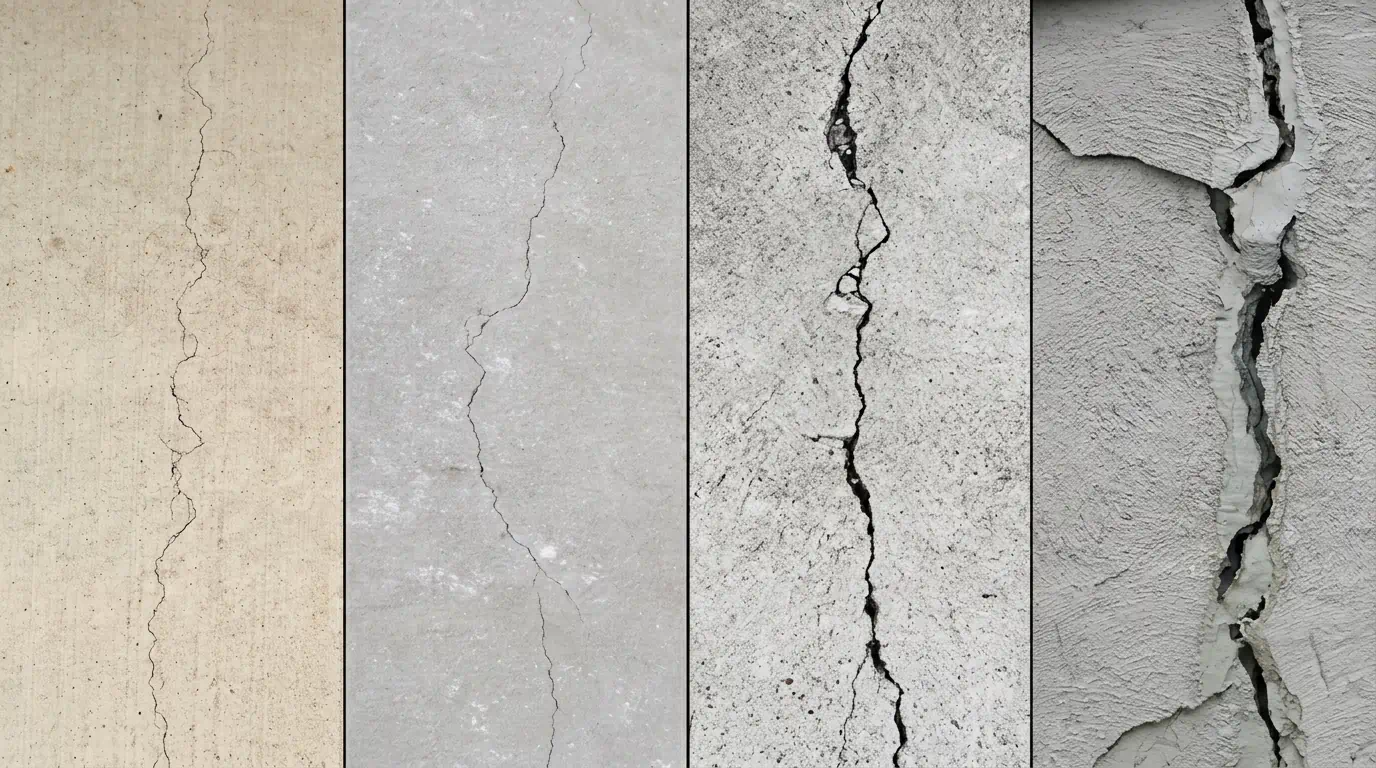
Concrete cracks are among the most common defects in structural elements. For industrial, commercial, and infrastructure facilities, it is crucial not only to detect a crack but also to accurately determine the mechanism behind its formation. A visually similar surface feature could result from either natural processes within the concrete or serious issues involving the subgrade, foundation, or load distribution.
Shrinkage cracks in concrete occur due to a reduction in volume during drying and hardening. This process is influenced by the concrete mix composition, water-cement ratio, curing conditions, temperature, humidity, drying rate, and reinforcement details. Surface shrinkage cracks can appear quite early—even during the concrete formation stage. However, by no means is every crack caused by shrinkage.
Cracks can arise from uneven foundation settlement, deformation of the subgrade, inadequate base preparation, excessive or uneven loads, reinforcement errors, thermal deformation, structural movement, and vibration. For industrial concrete flooring, the condition of the base is particularly important: unstable or unevenly compacted soil can lead to slab deformation and cracking.
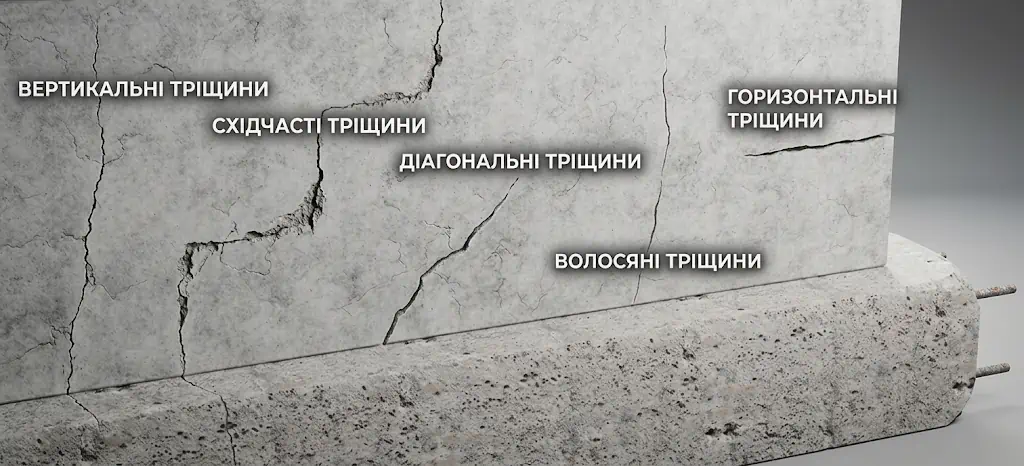
It is impossible to distinguish between harmless surface shrinkage and a structural issue based solely on the presence of a crack. One must evaluate its location, orientation, width, depth, length, and progression, while also comparing the defect against other signs of building deformation.
For instance, a fine network of surface cracks with no apparent link to the foundation or structural loads may simply be due to shrinkage. Conversely, cracks that penetrate the entire thickness of a structural element, exhibit significant width, or progressively widen require detailed inspection. Particular attention should be paid to cracks associated with uneven settlement, structural tilting, or changes in the building’s geometry. Sealing a crack before identifying its cause risks the recurrence of damage after repairs. The modern approach entails first determining the mechanism of deformation and only then selecting the appropriate restoration method.
What danger do cracks in concrete structures pose?
The consequences depend not so much on the mere appearance of the crack as on its origin and subsequent development. If the crack is linked to deformation of the base, it may simply be an external manifestation of a process occurring beneath the structure. For example, uneven soil settlement alters the load distribution within the foundation or slab and creates additional stresses in the concrete. In such a case, surface repair does not halt the deformation.
Water can penetrate the structure through open cracks. For reinforced concrete, this creates an additional risk of reinforcement corrosion, while freeze-thaw cycles can accelerate concrete deterioration. Moisture also has a detrimental effect on masonry and repair materials.
In industrial facilities, floor cracks can be accompanied by level differences, joint deterioration, the formation of voids, and a localized loss of load-bearing capacity. This imposes additional stress on transport and processing equipment and may hinder the normal operation of the premises.
Faq
Can the crack simply be filled with putty?
Only after the cause has been identified. If the structure continues to deform, surface repairs will not eliminate the root cause.
Does a crack in the concrete indicate a foundation problem?
Not always. However, if distortions, settlement, or other cracks appear simultaneously, the condition of the foundation must be checked.
How to repair cracks: Stati-CAL, Georesin, and Inject
In cases where cracks result from structural or geotechnical issues, the repair must address the specific mechanism of the damage. That is why Geotechnical Engineering Systems employs a combination of various technologies, each addressing a specific aspect of the task.
Georesin — addressing the root cause of the problem
If cracks are caused by soil subsidence, loosening, or insufficient load-bearing capacity, it is necessary to address not only the concrete itself but also the structural base.
The Georesin geopolymer injection technology allows for targeted soil treatment without the need for large-scale foundation excavation or structural dismantling. The material is injected through small access holes, filling voids and compacting the soil mass to enhance its load-bearing capacity and stability. Depending on the specific requirements, the injection process can be used for base stabilization as well as for the controlled lifting and leveling of structures.
This approach represents a fundamental departure from cosmetic repairs: it eliminates the root cause of the deformation in the concrete element.
Stati-CAL — structural reinforcement
If a crack has already compromised the structural integrity, it is necessary to restore the structure’s load-bearing capacity.
Stati-CAL systems are used for the structural repair of cracks and the reinforcement of walls, foundations, openings, and other structural elements. Helical bars and anchors create the necessary structural connections between separate parts of an element and distribute loads across a larger area of the structure.
This is crucial in situations where the crack results from structural movement rather than being merely a surface defect. The goal of the repair is not to mask the damage, but to restore the structure’s ability to function as a unified whole.
In cases where soil injection reinforcement methods are unsuitable, Stati-Pile driven piles offer a solution. Installing and connecting them to existing concrete foundations ensures stable structural support, even in challenging soil conditions.
Inject — filling of cracks and internal voids
For concrete and reinforced concrete structures, the “Inject” method allows for the filling of cracks and hidden internal voids with injection materials. The work is carried out via pre-installed packers, with the material delivered directly into the damaged area. The high penetrative capacity of the injection compounds enables treatment not only of the visible surface but also of the defect’s internal structure.
The result is the restoration of structural integrity, reduced water ingress, and increased durability of the repaired section. This technology is applied to foundations, walls, columns, floor slabs, reservoirs, underground structures, and other concrete elements.
Thus, this comprehensive solution operates on three levels. Additionally, a gel-composite mixture can be injected to stabilize the underlying soil—either as a standalone solution or in conjunction with Georesin geopolymers, which are used for the high-precision lifting of structures following soil stabilization.
The specific combination of methods is determined following an assessment. Not every crack requires all three technologies; therefore, technical diagnostics are an essential part of devising the correct solution. Work involving structural stabilization and lifting should commence only after a comprehensive assessment of the subgrade and foundations.
Why do traditional methods not yield the desired result?
Is it enough to widen and fill the crack?
Routing and filling can be effective for isolated, stable defects. However, if the crack resulted from ongoing structural deformation or foundation settlement, simply sealing it again will not address the root cause. The engineering solution must take into account the mechanism behind the defect and eliminate it.
Why doesn’t a new layer of concrete solve the problem with the base?
If concrete deforms due to a weak or uneven base, adding an extra layer of material increases the structure’s mass but fails to address the root cause of the settlement. In cases involving problematic soil, it is essential to stabilize the base itself. Georesin employs injection technologies to fill voids, compact the soil, and enhance its load-bearing capacity.
Will rebar alone be sufficient for tying it together?
A metal element installed without analyzing the structure’s behavior can create a local stress concentration. In the presence of micromovements, a crack may reopen or a new one may appear nearby. We provide comprehensive solutions, not haphazard reinforcement installation based merely on visual estimation.
How does injection differ from surface repair?
Surface repair addresses only the accessible part of the defect. Injection allows material to be introduced into the internal structure of the damaged component via packers, filling cracks and micro-voids deep within the element.
Why is there no single universal method for all cracks?
This is because cracks that look identical on the surface can stem from different causes. Modern building structures combine concrete, brick, various types of substrates, reinforcement, and finishes, and a crack itself may be static or propagate under the influence of loads and vibrations.
Areas of application
The comprehensive solutions offered by “Geotechnical Engineering Systems” are applied to industrial facilities, warehouse and logistics complexes, retail and office buildings, infrastructure projects, underground structures, reservoirs, and other constructions where it is necessary to restore structural integrity and operational reliability without extensive dismantling.
Ideally suited for facilities where repairs must be carried out with minimal disruption to production processes.


Solving the problem instead of temporarily masking it
Shrinkage cracks in concrete do not, in themselves, necessitate major repairs. The problem arises when a defect that looks like a simple crack actually masks a different underlying mechanism—such as uneven settlement, base deformation, structural errors, overloading, or issues with adjacent elements. That is why professional concrete structure repair begins with identifying the root cause, rather than simply selecting a crack-filling compound.
Consequently, our specialists assess the condition of the structures and the soil base, determine the deformation mechanism, and select the appropriate technology. Georesin enables base stabilization and high-precision structural lifting; Stati-CAL restores the structural integrity of damaged elements; and Inject fills cracks and internal voids.
This approach makes it possible to distinguish between standard operational defects and hazardous structural issues, ensuring that the scope of intervention is precisely tailored to the specific facility.
For a business owner or technical director, this means more than just a repaired surface; it ensures the rapid restoration of the structure, taking into account the cause of the damage, operating conditions, and future load requirements.