

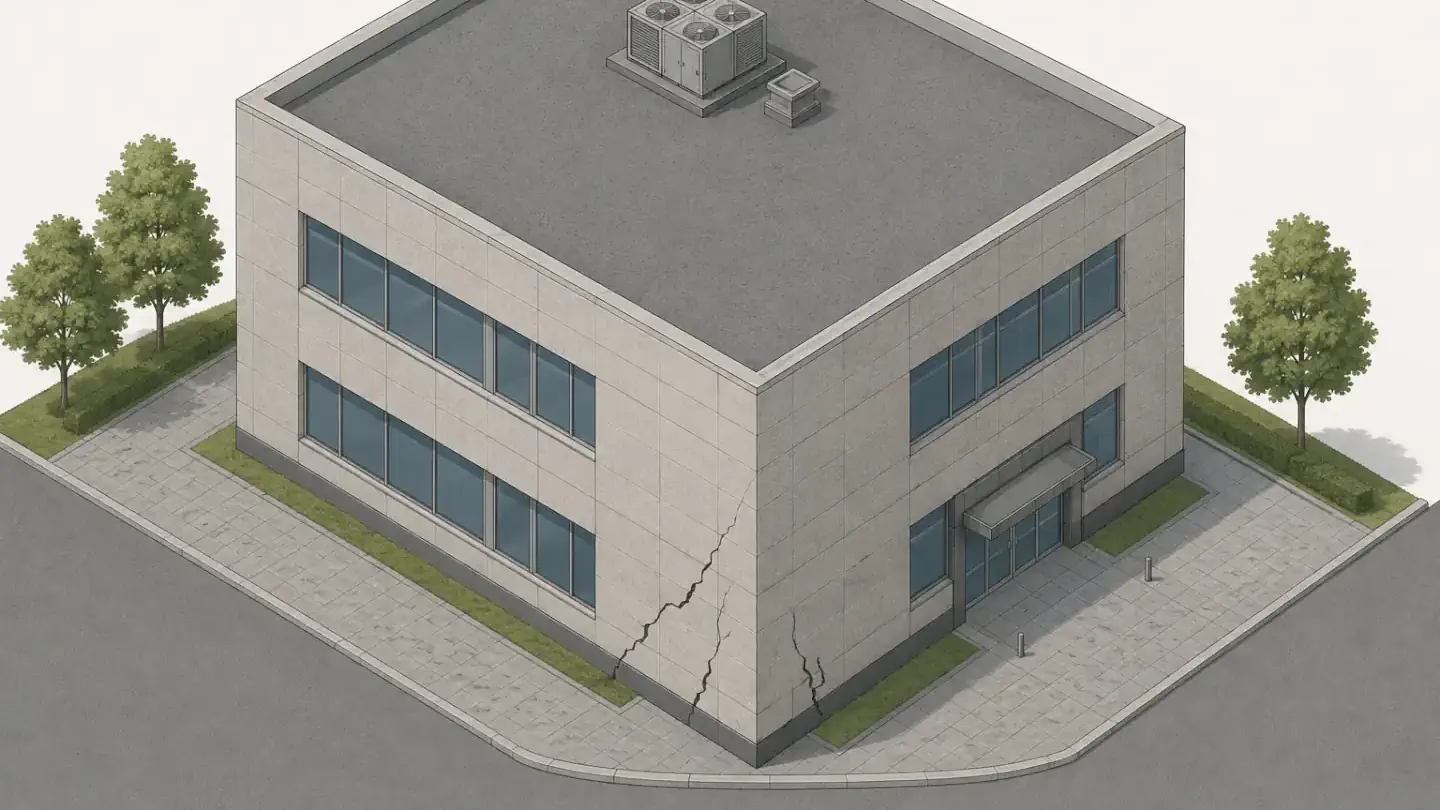
Building corner subsidence
Causes, risks, and comprehensive solutions
Why is one corner of the building starting to sink?
Uneven settlement at one corner of a building is a clear indication that the structure-foundation-soil system is behaving inconsistently across different zones. Unlike uniform settlement, localized deformation causes the building to tilt, redistributes loads between walls and foundations, and can trigger a chain reaction of secondary damage.
The root cause often lies not in the corner itself, but in the underlying soil. Soil heterogeneity, inadequate fill compaction, old trenches and utility lines, voids, or weak soil strata can create a zone with reduced load-bearing capacity. Under load, such an area compresses more significantly, causing the foundation corner to sink relative to the rest of the building. Contributing factors include high moisture levels, utility leaks, fluctuations in the groundwater table, the washing out of fine soil particles, vibrations from machinery or traffic, and increased operational loads.
Localized settlement is particularly critical for slab foundations: because the slab acts as a single, rigid platform, deformation in one area alters the stress-strain state of the entire structure. Typical signs include vertical cracks, distortion of door and window openings, gaps between the floor and walls, and localized changes in floor levels.
Dangers and consequences
When a corner settles, the building tilts or undergoes localized distortion. Loads are no longer distributed as intended in the design. Tensile stresses arise in brick and stone masonry, manifesting as vertical, diagonal, or “stepped” cracks. Such defects are particularly critical at the corners, as these zones ensure the building’s structural rigidity.
For B2B facilities, the consequences extend beyond the facade. Deformation can affect floor slabs, utility systems, openings, and industrial equipment. In manufacturing or warehouse settings, foundation tilting can lead to a loss of precision, increased vibration, and the need for unscheduled repairs.
If the settlement continues, simply repairing the crack or the finish merely masks the symptoms of the deformation. It is essential to determine whether the process is active, where the structural equilibrium has been compromised, and what the soil properties are. Professional diagnostics involve data collection, soil analysis, measurements of settlement and tilt, and risk assessment.
Faq
Does the subsidence of one corner always indicate a critical condition?
The danger is determined by the nature and dynamics of the deformation. A specialist should assess the severity of the damage.
Is it possible to reinforce only the foundation?
Not always. Damaged masonry may require specific structural restoration.
Comprehensive solution: Georesin + Stati-CAL + Inject
The appropriate strategy depends on the deformation mechanism. If the cause lies in a weak or heterogeneous base, the soil is stabilized first. If the masonry is already damaged, structural connections and the internal integrity of the defective areas are restored concurrently.
Georesin — stabilization of the base
Georesin geopolymer injection allows for targeted soil treatment without the need for large-scale foundation excavation. The material is injected into the zone beneath the foundation through small holes. The geopolymer expands, filling voids, compacting weak areas, and improving the load-bearing characteristics of the subgrade. Under certain conditions, this controlled expansion can also be used to correct the position of a structure that has settled.
This is particularly important for localized settlement: the treatment targets the specific problem area without requiring reconstruction of the entire foundation.
Stati-CAL — resumption of constructive work
Once the foundation has been stabilized, damaged walls and structural connections are restored. Stati-CAL systems utilize stainless steel helical bars and anchors to transfer tensile forces and distribute loads across a larger area of the masonry. This makes it possible not merely to seal a crack, but to restore structural interaction between separate sections of the wall. This approach is particularly important for corners, cracks, and sections of the wall that have pulled away.
Inject — repair of cracks and voids
If internal cracks, localized voids, or zones of loosened material have formed alongside the settlement, injection allows for the filling of defects deep within the structure. This stage complements ground stabilization and structural reinforcement in cases where the integrity of the damaged area needs to be restored.
Thus, the integrated system operates on three levels: Georesin for geotechnical stabilization, Stati-CAL for structural restoration, and Inject for filling internal defects. This approach makes it possible to address not just the symptoms, but the underlying mechanism of deformation.
Чому традиційні технології не забеспечують якісний результат?
Why is underpinning the foundation with concrete insufficient?
A concrete bedding layer can increase the bearing area, but in cases of locally weak or water-saturated soil, it does not necessarily eliminate the cause of differential settlement. The work requires exposing the foundation and significantly altering the existing structure.
Can a complete replacement of the foundation solve the problem?
In critical cases, replacing the foundation or transferring the load to piles may be necessary. However, this is a complex, time-consuming, and invasive solution. If the existing foundation can be preserved, localized grouting or strengthening often allows the scope of intervention to be limited.
Is it possible to limit the work to tying the structures together?
Such elements can restrain deformation but do not restore the soil’s properties. If settlement continues, the structure continues to deform. It is advisable to use Stati-CAL in conjunction with foundation stabilization when it is necessary to restore the load-bearing capacity and structural integrity of the walls.
Why and when should Stati-PILE sectional piles be used?
If the foundation is severely damaged or weak soil layers lie beyond the reach of injection technology, pile reinforcement may be required. A comprehensive approach does not rule out traditional methods but allows for their use where they are truly necessary.
Areas of application
The comprehensive solutions offered by Geotechnical Engineering Systems are used for industrial and commercial buildings, warehouses and logistics centers, manufacturing facilities, retail and office complexes, and infrastructure projects, as well as for structures with slab or pile foundations. For the chemical, pharmaceutical, and food industries, speed of execution, safety, and the minimization of downtime are of particular importance.
We have successfully completed over 2,000 projects across Ukraine, restoring reliability and safety to buildings of various types. We employ a unique set of modern technologies that enable the restoration of buildings and structures quickly, efficiently, and cost-effectively.
The company “Geotechnical Engineering Systems” specializes in innovative engineering solutions tailored to the needs of clients across various industries.


Comprehensive solution
The settlement of a single corner of a building indicates a breakdown in the interaction between the soil, the foundation, and the wall structures. Effective remediation must begin with an engineering assessment, which serves as the basis for developing a technical solution and selecting the specific technologies and methods to rectify the deformation.
“Geotechnical Engineering Systems” employs a comprehensive approach: identifying the settlement mechanism, stabilizing weak zones in the foundation’s soil base through soil injection, restoring the structural integrity of walls using Stati-CAL systems, and—where necessary—injecting cracks and voids using the Inject technology.
For B2B projects, the goal of such a solution is not merely to eliminate a visible defect but to stabilize the structure, minimize the risk of recurring deformation, and ensure the building remains fully operational. The earlier the cause of localized settlement is identified, the greater the opportunity to employ minimally invasive engineering solutions rather than resorting to complete demolition or foundation replacement.